smyile/rustmail
https://rustmail.app | A self-hosted SMTP mail catcher with web UI, REST API, and CI assertions.
4.0K
smyile/rustmail repository overview

RustMail
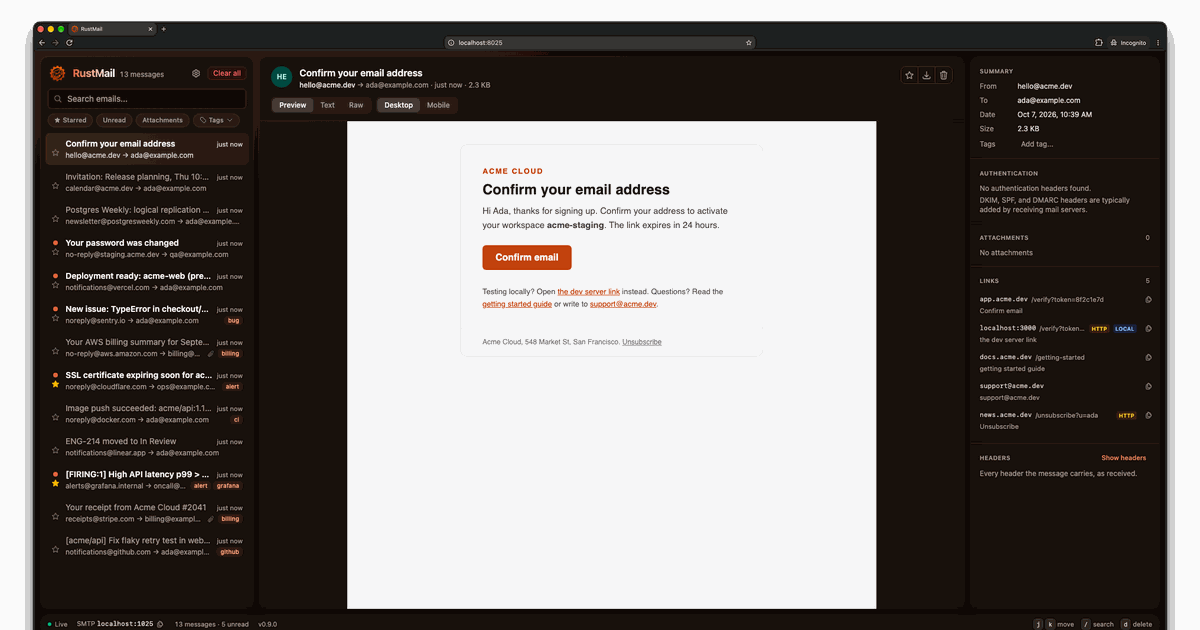
A local SMTP mail catcher for development and CI, built in Rust. Your app sends email to RustMail instead of a real server, and every message lands in a web UI where you can inspect it, search it and assert on it in tests.
Website: rustmail.app · Docs: docs.rustmail.app · GitHub: rustmailapp/rustmail
Quick Start
docker run -p 1025:1025 -p 8025:8025 smyile/rustmail:latest
Point your app's SMTP at localhost:1025, then open localhost:8025. Emails show up in real time.
Coming from MailHog or Mailpit? RustMail uses the same default ports, SMTP 1025 and HTTP 8025, so your app's SMTP settings stay as they are.
Docker Compose
services:
  rustmail:
    image: smyile/rustmail:latest
    ports:
      - "1025:1025"
      - "8025:8025"
    security_opt:
      - no-new-privileges:true
    volumes:
      - rustmail-data:/data
    restart: unless-stopped

volumes:
  rustmail-data:
Supported Architectures
| Architecture | Tag |
|---|---|
linux/amd64 | latest |
linux/arm64 | latest |
linux/arm/v7 | latest |
Multi-arch manifest: Docker automatically pulls the correct image for your platform.
Persistence
The image stores emails at /data/rustmail.db by default. Mount a volume to /data to persist emails across container restarts.
For ephemeral (CI) usage, skip the volume:
docker run -p 1025:1025 -p 8025:8025 -e RUSTMAIL_EPHEMERAL=true smyile/rustmail:latest
Environment Variables
All configuration is done via RUSTMAIL_* environment variables:
| Variable | Default | Description |
|---|---|---|
RUSTMAIL_BIND | 0.0.0.0 | IP address to bind listeners to |
RUSTMAIL_SMTP_PORT | 1025 | SMTP listener port |
RUSTMAIL_HTTP_PORT | 8025 | HTTP and WebSocket port |
RUSTMAIL_DB_PATH | /data/rustmail.db | Path to SQLite database file |
RUSTMAIL_RETENTION | 0 | Auto-delete messages after N hours (0 = keep forever) |
RUSTMAIL_MAX_MESSAGES | 0 | Max messages to retain (0 = unlimited) |
RUSTMAIL_MAX_MESSAGE_SIZE | 10485760 | Max accepted message size in bytes (10 MB) |
RUSTMAIL_SMTP_TLS_CERT | unset | Path to a PEM certificate for optional SMTP STARTTLS |
RUSTMAIL_SMTP_TLS_KEY | unset | Path to a PEM private key for optional SMTP STARTTLS |
RUSTMAIL_EPHEMERAL | false | Use in-memory SQLite (no data written to disk) |
RUSTMAIL_WEBHOOK_URL | unset | URL to POST on every new message |
RUSTMAIL_LOG_LEVEL | info | Log verbosity: trace, debug, info, warn, error |
RUSTMAIL_RELEASE_HOST | unset | Allowed SMTP target for email release (host:port) |
RUSTMAIL_ALLOWED_HOSTS | unset | Comma-separated host names browsers may reach RustMail on, such as mail.example.com. IP addresses and localhost are always answered |
RUSTMAIL_ALLOWED_ORIGINS | unset | Comma-separated extra origins allowed to open the WebSocket, as scheme://host[:port] |
RUSTMAIL_WS_BUFFER | 4096 | WebSocket events buffered for each client |
See the configuration reference for every option.
Ports
| Port | Protocol | Description |
|---|---|---|
1025 | TCP | SMTP server |
8025 | TCP | HTTP API, WebSocket, and Web UI |
Optional STARTTLS
STARTTLS uses the normal SMTP port via explicit upgrade. Both RUSTMAIL_SMTP_TLS_CERT and RUSTMAIL_SMTP_TLS_KEY are required; setting only one fails startup, and STARTTLS is advertised only when both are set.
Mount your TLS files read-only and set both environment variables:
docker run \
  -p 1025:1025 -p 8025:8025 \
  -v "$PWD/certs:/certs:ro" \
  -e RUSTMAIL_SMTP_TLS_CERT=/certs/smtp-cert.pem \
  -e RUSTMAIL_SMTP_TLS_KEY=/certs/smtp-key.pem \
  smyile/rustmail:latest
Clients must issue EHLO, then STARTTLS, and then EHLO again after the TLS handshake completes.
Test emails in CI
Run the image as a service container, or use the RustMail GitHub Action, then fail the build when an email is missing:
curl -f "localhost:8025/api/v1/assert/count?min=1&subject=Welcome"
The endpoint answers 200 when the condition holds and 417 otherwise. See CI integration.
Features
- Persistent storage: SQLite-backed, emails survive restarts
- Full-text search: FTS5 across subject, body, sender, and recipients
- Real-time updates: WebSocket pushes new emails to the UI instantly
- Modern UI: dark-mode-first, looks and feels like a real email client
- DKIM/SPF/DMARC/ARC display: parses authentication headers with color-coded badges
- REST assertion endpoints:
GET /api/v1/assert/count?min=1&subject=Welcome - Webhook notifications: fire-and-forget POST on new email
- Email release: forward captured emails to a real SMTP server
- Export: download as EML or JSON
- Retention policies: auto-purge by age or count
Image Details
- Base image:
alpine:3.21 - Runs as: non-root user
rustmail - Healthcheck: built-in (HTTP check every 30s)
- Volume:
/data - Security:
no-new-privilegesrecommended
License
Licensed under either of MIT or Apache 2.0, at your option.
Tag summary
Content type
Image
Digest
sha256:9b53d1f7c…
Size
9.2 MB
Last updated
17 days ago
docker pull smyile/rustmail